# What is a Kilonova?
On August 17, 2017, the LIGO/Virgo detector network observed **GW170817**, the first ever gravitational‑wave signal detected from a binary neutron‑star merger. What made this discovery even more exciting was the observation of a gamma-ray burst, and electromagnetic radiation alongside the original GW signal, making it the first confirmed multi-messenger event. Further analysis of electromagnetic radiation from this event established NS-NS mergers as sites of heavy-element synthesis (beyond Iron), but it has not been confirmed whether they occur frequently enough to explain the abundance of these elements in our universe.
### What Are Neutron Star Mergers?
Neutron stars are the densest objects in the universe apart from black holes. They form when a star of roughly 10 to 25 solar masses (M☉) ends its life in a supernova. Stars often exist not in isolation but in pairs, orbiting a shared centre of mass. If both stars in such a pair are massive enough, each will eventually explode in a supernova, leaving behind a binary system of two neutron stars.

The neutron stars' intense gravity forces them into an inspiral. As they orbit each other, they emit gravitational waves (ripples in space-time) that carry away energy and angular momentum. This loss of energy and momentum shrinks their orbits and reduces their eccentricity, making the orbits more circular. So, the stars spiral closer and closer together until they finally collide. It is strongly believed that the merger forms a hypermassive neutron star, which then collapses into a black hole and releases a powerful burst of light called a *kilonova*.
### The AT2017gfo Kilonova
A 'kilonova' is an optical transient powered by the radioactive decay of heavy elements synthesized in the merger ejecta via the r-process (explained in the next section). An interesting property of this kilonova was the rapid colour evolution from blue to red over the duration of ~10 days, caused by the expansion and cooling of the ejecta. Since the ejecta acts as a [black body](https://webwidewit.com/decoding-the-colors-of-stars), we know that the peak of the light curve should move from the blue wavelengths into the near-infrared region, much as it would for any cooling blackbody. BUT the distinguishing feature was how long the kilonova remained bright in the infrared, producing a longer, dimmer, and redder light curve than observed in other transients such as supernovae. This deviation from the behaviour of a pure black body spectrum at late times indicates the synthesis of heavy elements within the ejecta, which increases its opacity, trapping blue light and re-emitting it at redder wavelengths. This light curve evolution is shown in the plot below (Villar et. al, 2017) :
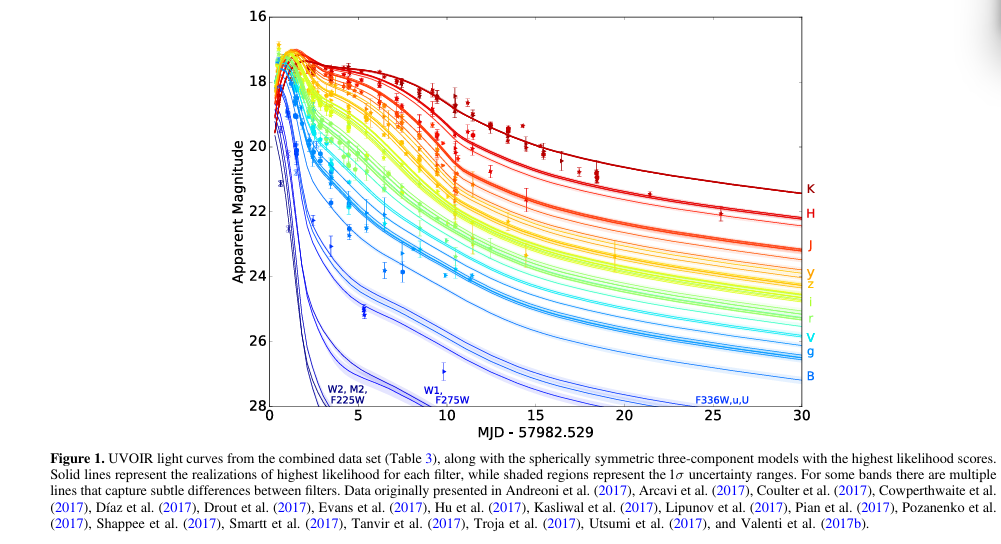 From this figure, it is obvious that the blue and UV bands fade quickly, while the near-infrared bands (J, H and K bands) fade far more slowly. Keep in mind that [magnitude](https://webwidewit.com/decoding-the-colors-of-stars)s run in reverse, so a brighter object has a *lower* magnitude (which is why the y-axis is flipped, and the infrared bands are towards the top of the plot).
### What is r-process nucleosynthesis?
We know that stars generate energy by fusing Hydrogen atoms into Helium (*α particles)* inside their core. These Helium atoms then combine into Carbon atoms, which combine to form Neon, and the cycle continues. At least, it continues until the formation of Iron. Fusion beyond Iron, however, becomes an endothermic process, meaning instead of releasing energy, it consumes energy from the star. This disrupts the balance between gravity, which pulls the star inwards, and the nuclear energy provided by fusion, that pushes the star outward, keeping it from collapsing in on itself. Once this balance is gone, the star explodes in a core-collapse supernova.
Now, the question that remains is if fusion stops at Iron, how are heavier elements such as Neodymium, Uranium, Gold etc. created? Well, there are two ways this can happen, namely, proton and neutron capture. In our case however, owing to the neutron-rich environment of NS-NS mergers, the latter occurs. To be more specific, heavy elements are synthesized in the ejecta of the merger via the **rapid neutron capture** process.
In the rapid neutron capture process, atomic nuclei gain neutrons faster than they can beta-decay, increasing the neutron number and decreasing the stability of the nuclei until it comes to a point where no more neutrons can be added. The nucleus then undergoes beta-decay, forming heavy elements, in particular, lanthanides.

(Image from : )
### How do Lanthanides impact the colour evolution of the Kilonova?
The Lanthanide series consists of elements with atomic numbers 57-70 on the periodic table. We know that the periodic table is subdivided into 4 groups, namely the s-, p-, d-, and f- block, based on which sub-shell the elements' valence electron(s) land in. Lanthanides are represented by the general electronic configuration *\[Xe\] 4fⁿ 5d⁰–¹ 6s²* , and are located in the f-block as they have partially filled 4f-sub shells.

Lanthanides significantly contribute to ejecta opacity, due to the complex structure of their partially filled f-subshell which creates a dense forest of spectral lines that allow for multiple atomic transitions. But what exactly does this mean? Well, we know that every shell (orbit) of an atom typically has an energy associated with it. The outermost/valence shells posses the highest energy levels, while the innermost shells have the lowest energy. When an electron in a higher energy (*excited*) state drops down to a lower energy (*ground*) state, it releases an amount of energy that is equal to the transition energy between the two states, given by :
$$E_\gamma = E_e - E_g$$
This energy (E) corresponds to a specific wavelength (λ) of light, given by:
$$\lambda = h\cdot c/E$$
where c is the speed of light in m/s and h is planck's constant.
\
A spectral emission line, is the bright line observed in a spectrum when such a transition happens, releasing energy (E) in the form of light at wavelength λ, which might correspond to a colour of light we can see visually if it lies in the visual spectrum, or observe with a telescope if in the IR/UV region. Similarly, the opposite can also occur. By absorbing energy equal to the transition energy between any two orbitals, an electron can jump up to a higher energy state from a lower energy state. **This means that an atom will absorb light having a wavelength corresponding to its absorption spectra.** *Also note that the absorption spectrum is the exact opposite of an emission spectrum.*
For example, the emission and absorption spectrum of the element Hydrogen is shown below:

Now, coming back to lanthanides, we know that since they have **more spectral lines** than lighter elements, they allow for many more bound-bound transitions (where electrons jump between energy levels). Additionally, the spectral lines are **Doppler-broadened** by the velocity gradients in the ejecta. This means particles in the ejecta move at different speeds relative to each other, so they don’t all absorb light at the exact same frequency as they would if they were stationary. As a result, the absorption lines spread out and overlap, creating a **pseudo-continuum of bound-bound opacity** (ability to block light) that is 10 to 100 times greater than that of iron, as shown below.

Because lanthanides’ absorption is strongest in the UV and blue regions, they have the **highest opacity** there. This lets them block UV radiation effectively by absorbing it and later re-emitting it at lower energies. Meanwhile, the **radioactive decay** of these elements provides the thermal energy that sustains the kilonova’s heat. As electrons in the lanthanides de-excite (drop down to a lower-energy state), they release energy as photons, mostly in the **near-infrared (NIR) and infrared (IR) wavelengths** (because lanthanides' emission spectrum is the strongest in those regions, as an emission spectrum is the exact opposite of an absorption spectrum).
This combined effect, called **‘***lanthanide line-blanketing***’**, suppresses the optical and UV emission and shifts the spectral energy distribution toward **IR and NIR wavelengths**. This produces the kilonova’s signature light curve: longer-lasting, dimmer, and redder than what would be seen with iron or nickel opacities.
### Why would we need a multi-component model for a kilonova?
To understand the components needed to model such a light curve, we first need to understand where the ejecta comes from. There are 2 distinct forms of ejecta in a binary neutron star merger:
1\. Dynamic ejecta
This is matter ejected dynamically during the coalescence (merger) phase due to the conservation of angular momentum, within milliseconds of the collision. There are two components that contribute to this type of ejecta:
- Tidal tail ejecta : This is the cold, neutron-rich component consisting of matter originating from the outer regions of the neutron stars. It is the material thrown out via tidal interaction in the **equatorial plane**. This ejecta has an extremely low electron fraction (*Ye* ~ 0.1), which allows it to rapidly assemble into heavy elements. The electron fraction is a critical quantity that allows us to determine whether r-process is viable:\\
$$Y_e = \frac{n_n}{n_n+n_p}$$
\(n_n = neutrons, \space n_p = protons\)\
\
*Note: the electron fraction (Ye) determines the composition of the ejecta: high Ye favors iron-group elements (low opacity, blue kilonovae), while low Ye produces lanthanides (high opacity in UV/optical, red kilonovae).*
- Shock-heated ejecta : This is the hotter component originating from the contact interface between the 2 neutron stars in the **polar** region. This component has a higher electron fraction as a result of external weak interactions, and thus it is not a major source of r-process nucleosynthesis.
2\. Post-merger disk wind:\
This is the material ejected from the accretion disk of the newly formed remnant of the merger. Similar to the shock-heater polar ejecta, this material also has a higher Ye as a result of neutrino (ve) interactions, which converts neutrons into protons in an inverse beta-decay proces given by :
$$v_e + n → p + e^-$$
Therefore, this component is also not a major source of r-process nucleosynthesis.
The geometry of a neutron-star merger is shown in the diagram below (Cowan et. al, 2021)
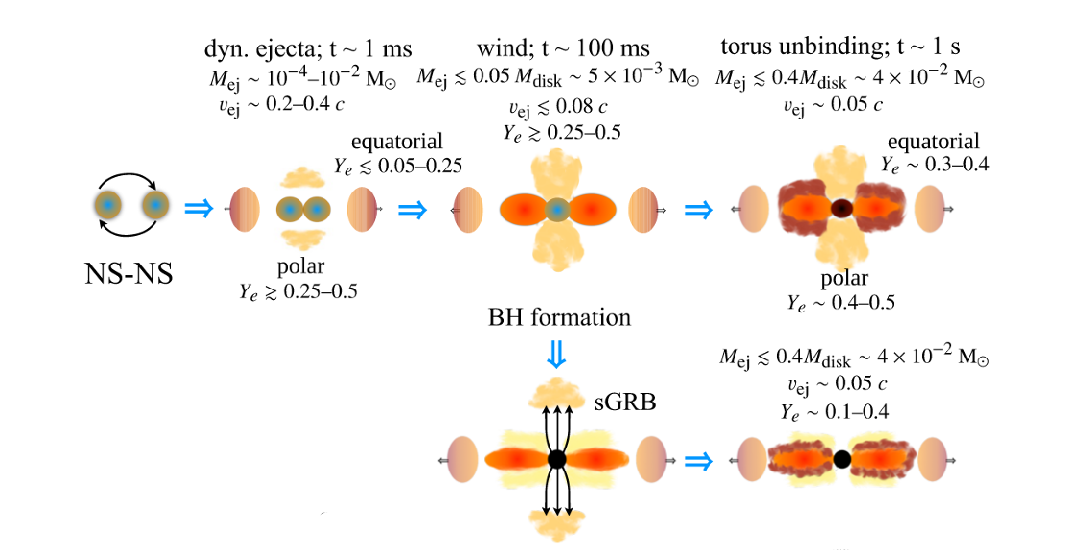 Since we have all these different components of the ejecta, each with a different electron fraction, different r-process rate, and consequently, a different lanthanide opacity, we need to model the light curves using distinct components. Models with a single opacity (κ) component failed to reproduce this observed colour evolution, suggesting the presence of at least two distinct ejecta components with different lanthanide fractions. According to Villar et. al, a three-component model consisting of a lanthanide-poor 'blue', intermediate 'purple', and lanthanide-rich 'red' ejecta was found to best fit the data, as detailed in the table below :
| | Blue | Purple | Red |
| --- | --- | --- | --- |
| **Mass** | 0.020 M☉ | 0.047 M☉ | 0.011 M☉ |
| **Velocity** | 0.27c | 0.15c | 0.14c |
| **Opacity** | κ = 0.5 cm² g⁻¹ | κ = 3 cm² g⁻¹ | κ = 10 cm² g⁻¹ |
| **Origin** | Shock-heated polar ejecta created when the neutron stars collide | Post-merger accretion disk outflow. The κ ≈ 3 cm² g⁻¹ component dominates the total ejecta mass | Dynamically ejected tidal tails in the equatorial plane (tidal stripping) |
| **Implications** | Dominates early blue/UV emission. Produces the hot 8300 K blackbody at 0.6 days. Produces light r-process elements (A ≲ 140) | Explains the intermediate-timescale red–NIR emission. Produces intermediate-mass r-process elements (A ≈ 90-160). | Dominates late-time NIR emission. Required to reproduce the very red colors after ~5 days. Produces heavy r-process (A > 140), including lanthanides and actinides |
| **Neutrino physics and electron fraction** | Ye ≈ 0.25 - 0.40. Polar region has an influx of neutrinos + a long exposure time as it is unobstructed + ideal temperature. νe + n → p + e⁻ (raises Ye) | Ye ≈ 0.20 - 0.35. Disk winds are exposed to moderate neutrino irradiation. Disk is hot + turbulent → neutrino interactions → raise Ye → antineutrino interactions reduce Ye → equilibrium | Ye ≈ 0.03 - 0.15. Cold, dense tidal ejecta, rapidly expelled, shielded from neutrino irradiation (νe flux blocked by equatorial material). High lanthanide fraction → very high opacity |
\
In the following articles of this series, my aim is to develop and test 1-,2- and 3- component kilonova models and fit them using emcee/bayesian inference to get best-fit parameters for the opacity, velocity, and Mass of the ejecta, to determine which model fits the data the best!
### References
Barnes, J., & Kasen, D. (2013). EFFECT OF A HIGH OPACITY ON THE LIGHT CURVES OF RADIOACTIVELY POWERED TRANSIENTS FROM COMPACT OBJECT MERGERS. *The Astrophysical Journal*, *775*(1), 18. [https://doi.org/10.1088/0004-637x/775/1/18](https://doi.org/10.1088/0004-637x/775/1/18)\
[\
](https://doi.org/10.1088/0004-637x/775/1/18)Cowan, J. J., Sneden, C., Lawler, J. E., Aprahamian, A., Wiescher, M., Langanke, K., Martínez-Pinedo, G., & Thielemann, F.-K. (2021). Origin of the heaviest elements: The rapid neutron-capture process. *Reviews of Modern Physics*, 93(1). [https://doi.org/10.1103/revmodphys.93.015002](https://doi.org/10.1103/revmodphys.93.015002)\
\
Kasen, D., Badnell, N. R., & Barnes, J. L. (2013). OPACITIES AND SPECTRA OF THE r-PROCESS EJECTA FROM NEUTRON STAR MERGERS. 774(1), 25–25. \
\
Villar, V. A., Guillochon, J., Berger, E., Metzger, B. D., Cowperthwaite, P. S., Nicholl, M., Alexander, K. D., Blanchard, P. K., Chornock, R., Eftekhari, T., Fong, W., Margutti, R., & Williams, P. K. G. (2017). The Combined Ultraviolet, Optical, and Near-infrared Light Curves of the Kilonova Associated with the Binary Neutron Star Merger GW170817: Unified Data Set, Analytic Models, and Physical Implications. *The Astrophysical Journal*, *851*(1), L21. [https://doi.org/10.3847/2041-8213/aa9c84](https://doi.org/10.3847/2041-8213/aa9c84)