
Series
Modelling the AT2017gfo kilonova using Python
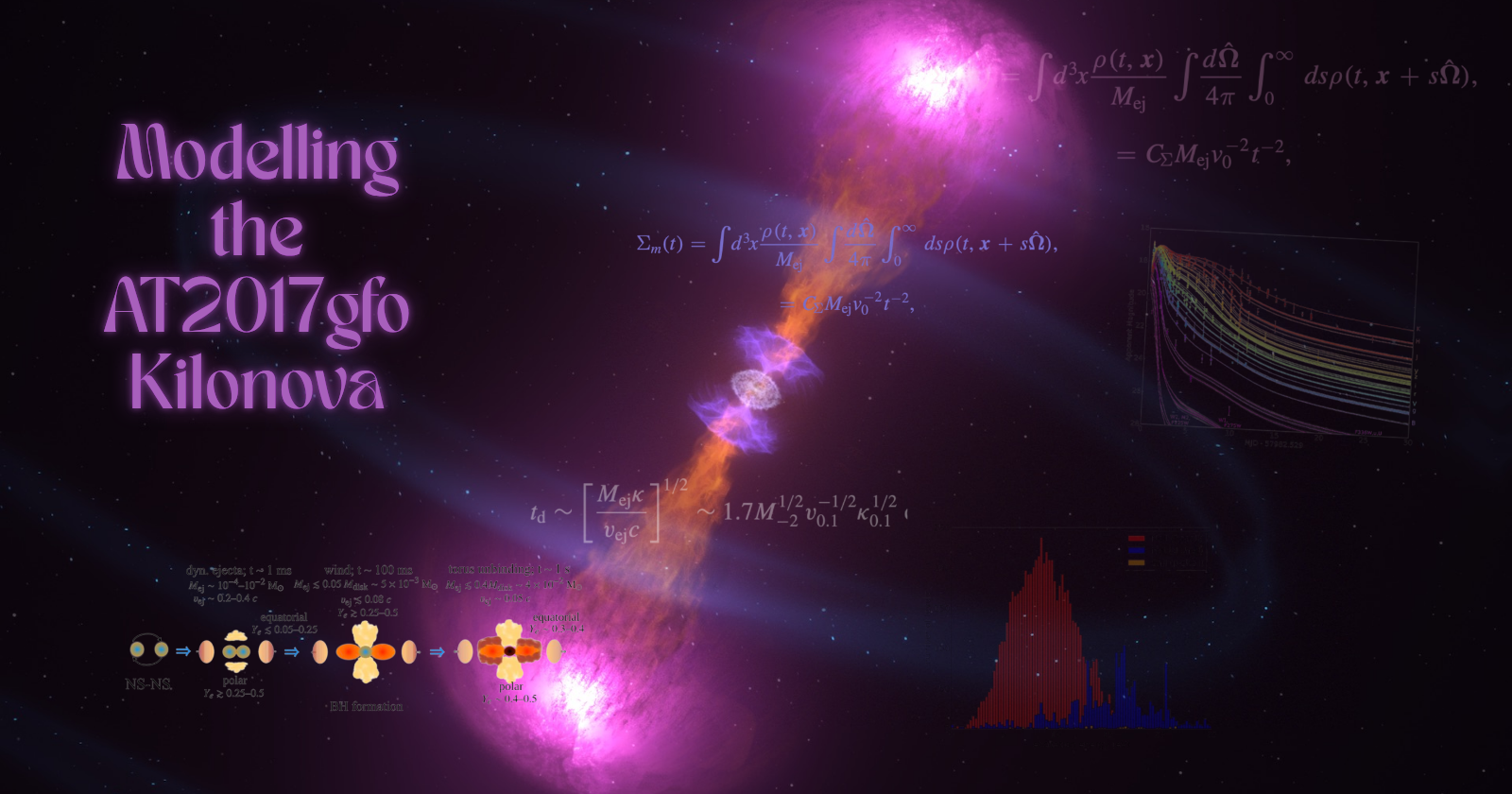
This project fits a semi-analytic, multi-component kilonova model to multiband photometry of AT2017gfo, the electromagnetic counterpart of the BNS merger GW170817, using Bayesian inference (MCMC and nested sampling). I test how many ejecta components the light curve requires, and whether it demands a lanthanide-rich, high-opacity component, by comparing one-, two-, and three-component models, and I compare my results with Villar et al. (2017). I then discuss what the inferred ejecta properties imply for r-process nucleosynthesis in neutron star mergers.
To start, I introduce python libraries such as astropy, numpy, matplotlib, etc, that will be used to clean and process the observed data, as well as the premise of AT2017gfo, and current research on the topic. I will then work towards building my own semi-analytic model, recreating the work of Villar et. al. Lastly, I will talk about the ongoing discussion of how BNS mergers might be the origin of heavy elements in the universe, as compared to Supernovae.
No posts yet